
Industrial Concrete Flooring Contractor: What to Look for Before Your Next Project

When you're building or expanding a warehouse, manufacturing facility, distribution center, or other industrial property, the concrete floor is one of the most important components of the entire project. It needs to support heavy equipment, withstand constant traffic, meet operational requirements, and continue performing for years.
That's why choosing the right industrial concrete flooring contractor matters.
Industrial concrete flooring is different from a typical concrete project. Large-scale industrial floors require careful planning, site preparation, the right concrete mix, reinforcement, accurate placement, professional finishing, and proper curing. Even small mistakes during construction can result in cracking, uneven surfaces, premature wear, or costly repairs.
Before selecting an industrial concrete contractor for your next project, here's what you should know about industrial concrete flooring and what to look for in an experienced team.
What Is Industrial Concrete Flooring?
Industrial concrete flooring is designed specifically for facilities that experience demanding operating conditions. While every project is different, industrial floors may need to withstand heavy equipment, concentrated loads, repetitive vehicle traffic, abrasion, chemicals, moisture, and temperature changes.
Common applications include:
Warehouses
Manufacturing facilities
Distribution centers
Production facilities
Agricultural buildings
Commercial buildings
Storage facilities
Pre-engineered metal buildings
Industrial expansions
The requirements of the facility should influence everything from concrete slab thickness and reinforcement to joint placement and finishing.
The American Concrete Institute provides industry standards and technical guidance covering concrete design, construction, placement, and performance.
Why Hire an Industrial Concrete Flooring Contractor?
Searching for an industrial concrete flooring contractor isn't the same as looking for someone to complete a small sidewalk or residential driveway.
Industrial projects can involve thousands of square feet of concrete and significant operational requirements. Contractors must coordinate concrete deliveries, crews, equipment, reinforcement, finishing, weather conditions, schedules, and quality control.
An experienced commercial concrete contractor understands how each stage affects the finished product.
Hiring the right contractor can help your project achieve:
Better floor performance
Greater durability
Appropriate load capacity
Improved floor flatness
Better crack control
Longer service life
Fewer repairs and disruptions
Your concrete floor becomes part of your everyday operations, making quality installation an investment in the facility itself.
1. Look for Commercial and Industrial Concrete Experience
One of the first things to consider is whether the contractor has experience completing projects similar to yours.
Industrial concrete requires different equipment, manpower, planning, and expertise than smaller concrete projects.
Ask potential contractors about their experience with:
Large concrete slabs
Warehouse floors
Manufacturing facilities
Commercial foundations
Industrial facilities
Equipment pads
Loading areas
A contractor familiar with industrial environments will better understand the demands the floor may experience once the facility becomes operational.

2. Understand Your Concrete Slab Requirements
There is no universal concrete slab design that works for every industrial building.
The appropriate slab thickness depends on factors such as:
Soil conditions
Equipment weight
Storage rack loads
Forklift traffic
Vehicle traffic
Building use
Point loads
Engineering specifications
A general warehouse might have completely different requirements than a manufacturing plant containing large pieces of stationary equipment.
Instead of selecting slab thickness based on a rule of thumb, the project team should evaluate actual anticipated loads and site conditions.
The Portland Cement Association provides additional technical resources related to concrete construction, pavement, and durability.
3. Proper Subgrade Preparation Is Critical
You can have a high-quality concrete mix and still experience slab problems if the material underneath it isn't properly prepared.
The subgrade and base beneath an industrial concrete floor provide support for the slab and help distribute loads.
Site preparation may involve:
Excavation
Grading
Soil evaluation
Compaction
Aggregate base placement
Moisture management
Poorly compacted or inconsistent supporting material can contribute to settlement, movement, and cracking.
An experienced industrial concrete flooring contractor understands that successful concrete work starts before concrete ever arrives on-site.
4. Choose the Right Concrete Mix
Concrete mix design also affects floor performance.
Industrial projects may specify requirements for compressive strength, workability, durability, shrinkage, air content, and other characteristics based on the intended application.
The correct mixture depends on the project rather than simply choosing the highest possible strength.
Ready-mixed concrete can also incorporate admixtures to modify characteristics such as setting time, workability, or cold-weather performance.
The National Ready Mixed Concrete Association offers educational resources about ready-mixed concrete, concrete construction, and performance.
Your contractor, engineer, and concrete supplier should work from the project's specifications to ensure the selected concrete is appropriate for the application.
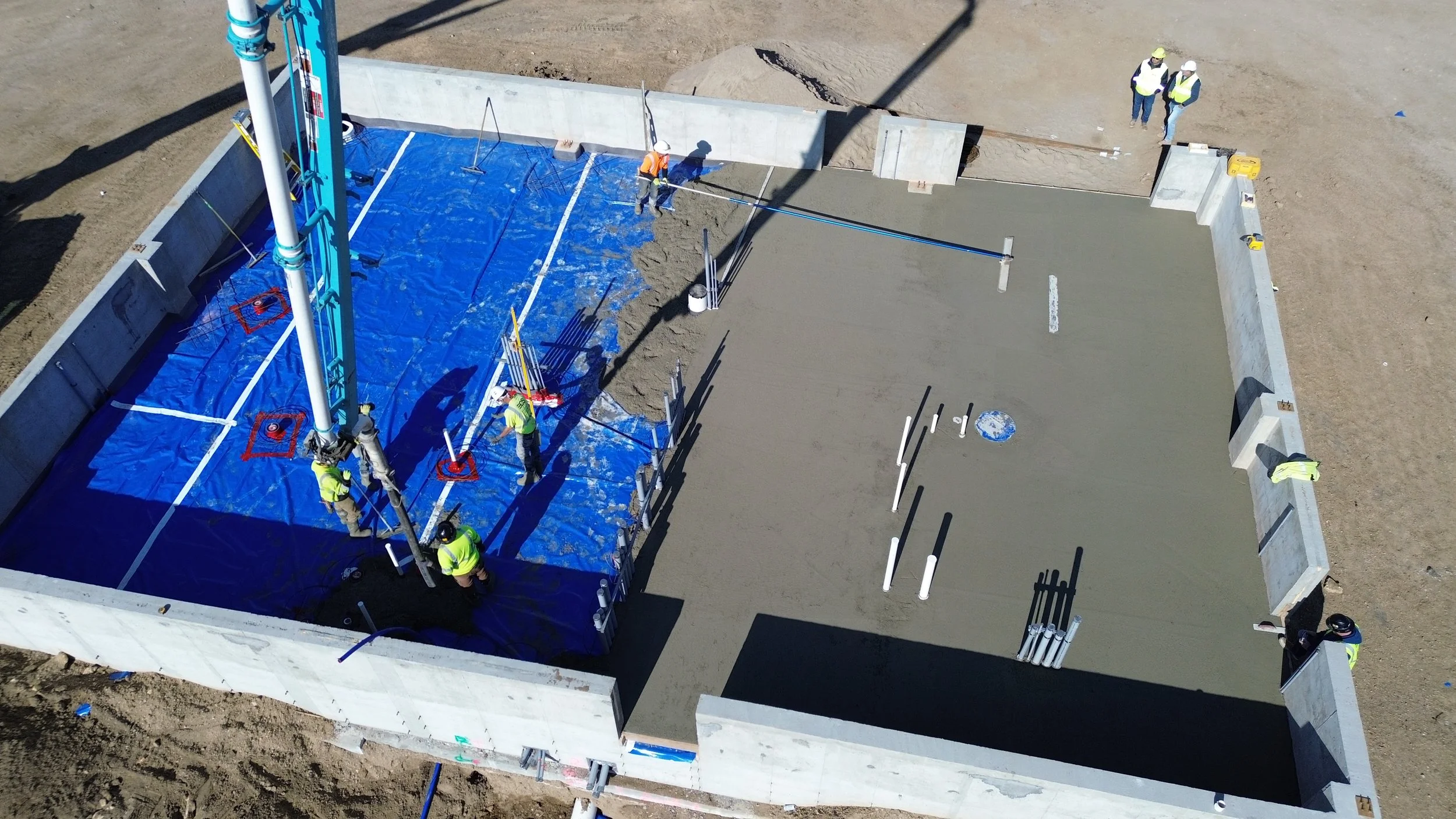
5. Determine the Right Reinforcement
Reinforcement can play an important role in industrial concrete floor construction.
Depending on the design, reinforcement may include:
Rebar
Steel reinforcing bars can help provide tensile capacity and control cracking according to the engineered slab design.
Welded Wire Reinforcement
Welded wire reinforcement may be specified to assist with crack control and reinforcement requirements.
Fiber Reinforcement
Certain industrial concrete mixtures incorporate synthetic or steel fibers. The type and amount depend on project specifications and performance requirements.
Reinforcement should not be viewed as a substitute for proper slab design, joint planning, site preparation, or curing. All of these components work together as part of the finished concrete flooring system.
6. Pay Attention to Floor Flatness and Levelness
For many industrial facilities, a floor simply looking flat isn't enough.
Warehouses and distribution centers may rely on forklifts, pallet systems, conveyors, robotics, and automated material-handling equipment. Floor variations can affect how efficiently that equipment operates.
Some projects therefore include specific floor flatness and floor levelness requirements.
These requirements should be established during project planning so the concrete contractor understands the expectations before placement begins.
For specialized warehouses with narrow aisles or automated systems, floor tolerances can become especially important.
7. Joint Planning Matters
Concrete changes volume as it hardens and responds to environmental conditions. Cracking cannot always be eliminated, but thoughtful joint design can help control where cracking occurs.
Industrial concrete floors may incorporate:
Contraction joints
Construction joints
Isolation joints
Joint location and spacing should account for slab geometry, columns, equipment, traffic patterns, and other building features.
For warehouses with frequent forklift traffic, joint performance can also affect the long-term condition of the driving surface.
8. Don't Overlook Concrete Curing
Finishing the floor doesn't mean the concrete process is finished.
Concrete curing plays an important role in developing strength and durability. Proper curing maintains conditions that allow cement hydration to continue after placement.
Depending on project specifications and conditions, curing methods may include curing compounds, wet curing, coverings, or other methods.
Temperature also matters. Hot, dry, windy conditions can increase moisture loss, while cold temperatures slow strength development.
The American Concrete Institute's curing resources provide additional information about why curing is essential to concrete performance.
An industrial concrete flooring contractor should plan for curing as part of the project—not as an afterthought.
9. Consider the Construction Schedule
Industrial construction schedules can move quickly.
Concrete work often affects multiple trades because other phases cannot proceed until the slab or foundation has reached the strength required for the next activity.
An experienced contractor should coordinate:
Site preparation
Reinforcement
Concrete deliveries
Placement sequence
Finishing
Curing
Weather protection
Access for other trades
For large industrial slabs, pour sequencing becomes particularly important because completing the entire floor in one placement may not be practical.
Good communication between the concrete contractor, general contractor, engineer, and other project partners helps keep the work moving efficiently.
How Much Does Industrial Concrete Flooring Cost?
One of the first questions owners and developers ask is, "How much does industrial concrete flooring cost?"
There isn't a single price that applies to every project.
Industrial concrete flooring costs depend on:
Total square footage
Slab thickness
Concrete specifications
Reinforcement
Subgrade conditions
Site accessibility
Labor requirements
Finishing requirements
Joint design
Weather conditions
Project location
Construction schedule
A basic warehouse floor will generally have different costs than a heavily reinforced manufacturing slab designed for concentrated equipment loads.
Instead of relying solely on a generic cost-per-square-foot estimate, owners should request pricing based on actual plans, specifications, site conditions, and operational requirements.
Questions to Ask an Industrial Concrete Flooring Contractor
Before selecting your concrete team, ask questions that help you understand their experience and approach:
Have you completed industrial projects similar to ours?
How do you approach large concrete slab placements?
How will you coordinate concrete deliveries and finishing?
What quality-control procedures do you use?
How do you handle hot- or cold-weather concrete?
What is your approach to curing?
How will your team coordinate with the general contractor and other trades?
The answers can tell you a great deal about how the contractor plans, communicates, and executes industrial concrete work.

Choosing an Industrial Concrete Flooring Contractor in Minnesota
Industrial facilities are long-term investments, and the concrete beneath them needs to be built with that same long-term perspective.
Choosing an experienced industrial concrete flooring contractor in Minnesota means finding a team that understands large-scale commercial concrete, demanding schedules, changing Midwest weather conditions, and the importance of getting the details right from preparation through curing.
Price matters, but experience, planning, safety, quality, communication, and proven commercial capabilities should all be part of your decision.
Looking for an Industrial Concrete Flooring Contractor? Contact ECS
At Evenson Concrete Systems (ECS), we know that strong industrial facilities start from the ground up. Our team provides commercial and industrial concrete solutions for warehouses, manufacturing facilities, commercial buildings, and other large-scale construction projects. From planning and site preparation through concrete placement, finishing, and curing, ECS focuses on delivering concrete work designed for long-term performance.
If you're searching for an industrial concrete flooring contractor for an upcoming project, involve the concrete team early. Understanding your building's use, schedule, site conditions, and performance requirements can help create a more efficient construction process and a better finished product.
Ready to discuss your next industrial concrete flooring project? Contact Evenson Concrete Systems today to connect with our team and start planning your commercial concrete project.