
Built for Growth: Meet Kaley Birr, Project Coordinator at Evenson Concrete Systems
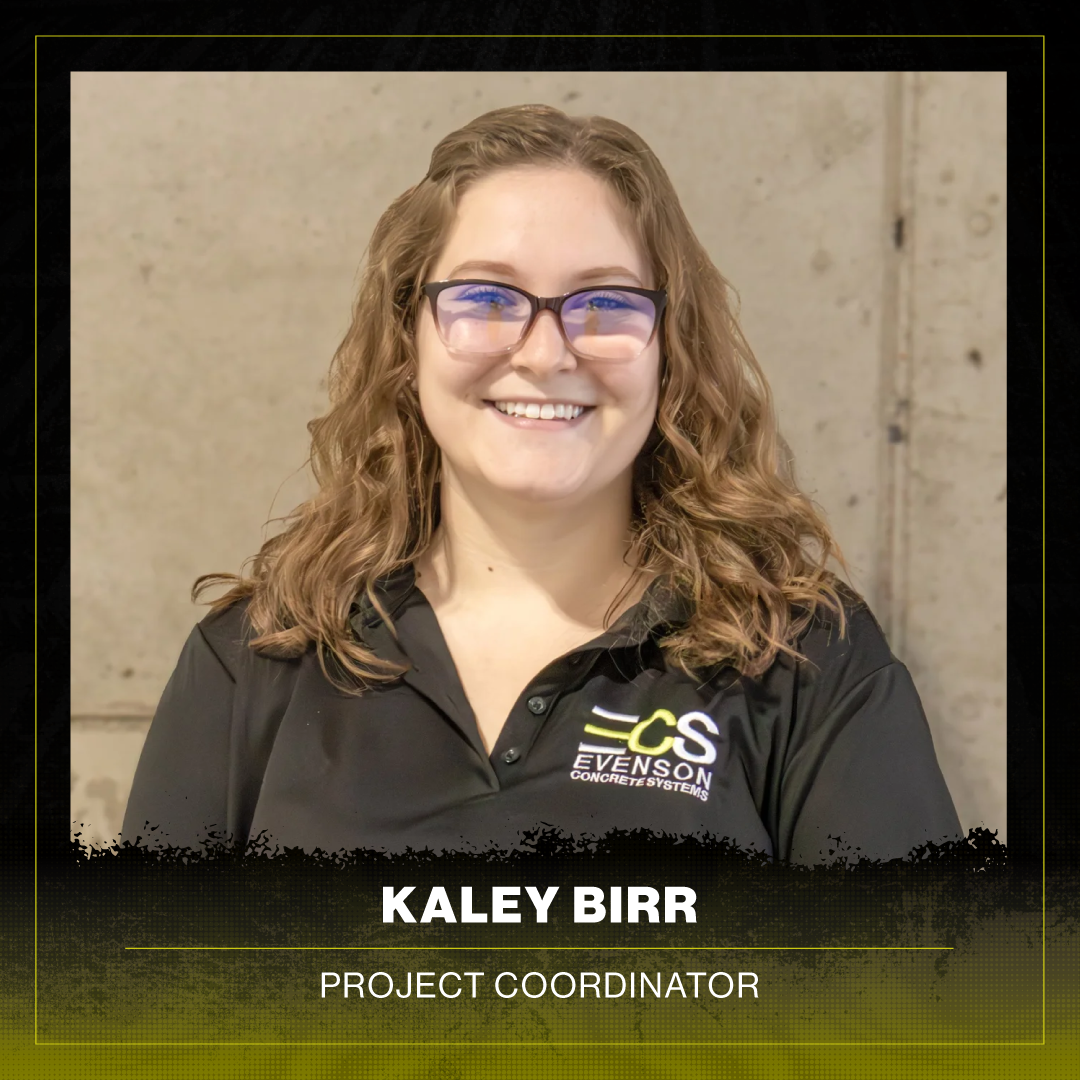
Behind every successful commercial concrete project is a team coordinating hundreds of details long before and long after the concrete is placed. Budgets need to be tracked. Schedules change. Materials and equipment need to arrive at the right time. General contractors, project managers, superintendents, vendors, and field crews all need accurate information to keep the project moving.
At Evenson Concrete Systems (ECS), Project Coordinator Kaley Birr helps connect those pieces.
As part of the ECS team, Kaley supports commercial concrete projects from award through completion, helping manage project documentation, budgets, schedules, communication, and changing project needs. Her role offers a look behind the scenes at what it takes to successfully coordinate commercial concrete construction and why teamwork is such an important part of the process.
Inside the blog:
What Does a Project Coordinator Do in Commercial Concrete Construction?
Commercial Concrete Projects Have a Lot of Moving Pieces
Communication Connects the Office and the Field
Problem-Solving Is Part of Construction
Learning the Business Behind Commercial Concrete
Growing a Career at ECS
A Culture Built Around Teamwork and Accountability
Advice for Starting a Career in Construction
What Does a Project Coordinator Do in Commercial Concrete Construction?
For Kaley, no two days look exactly the same. “As a Project Coordinator, I help keep our projects organized,” she said. “My day-to-day involves coordinating with Project Managers, Superintendents, General Contractors, and Vendors. I also keep track of budgets, scheduling, and project documentation.”
While concrete placement is one of the most visible stages of a project, significant coordination happens behind the scenes.
A Project Coordinator helps make sure the people responsible for executing the work have the information and resources they need.
Once ECS is awarded a project, Kaley helps establish the budget and organize contracts and project documentation. As construction progresses, she tracks changes, costs, schedules, and other important details.
“My role is to make sure the project team has the information and support they need to work effectively,” Kaley explained.
That organization becomes increasingly important as a commercial concrete project moves from preconstruction into active construction.
Commercial Concrete Projects Have a Lot of Moving Pieces
To someone outside the construction industry, a concrete project might appear straightforward: prepare the site, form the concrete, pour it, finish it, and move on.
The reality is considerably more complex.
“There are a lot of moving pieces,” Kaley said. “It takes a lot of planning and communication to coordinate materials, manpower, equipment, inspections, schedules, and other trades.”
Each piece can affect another.
Concrete deliveries need to coordinate with field crews and equipment. Inspections may need to happen before work can advance. Another trade's schedule can affect when the ECS team has access to an area. Changes to plans or site conditions may require adjustments to budgets, manpower, materials, or schedules.
Then there is one variable every Minnesota construction team understands: the weather.
“Weather and site conditions can also have a major impact, so being able to adapt is an important part of the job,” Kaley said.
From extreme summer heat to cold-weather concrete construction, changing conditions can influence how work is planned and executed. Organizations such as the American Concrete Institute and National Ready Mixed Concrete Association provide extensive industry guidance related to concrete construction, placement, curing, and weather-related considerations.
For ECS, successful execution requires combining that technical knowledge with communication and field experience.
Communication Connects the Office and the Field
One of the most important aspects of Kaley's position is communication. “I work closely with our Project Managers and Field Teams to make sure they have the information they need and that ECS stays aligned with the General Contractor and other project partners,” she said.
That connection between office and field helps keep everyone working toward the same project goals.
On a commercial construction project, information can change quickly. Updated schedules, revised drawings, change orders, material decisions, field conditions, and coordination with other trades can all affect the concrete scope.
Keeping information organized and communicating changes helps ECS respond efficiently while maintaining alignment with the project's general contractor.
For Kaley, seeing all that coordination become a finished project is one of the most rewarding aspects of her career.
“There are a lot of people involved in a project, both in the office and in the field,” she said. “It's rewarding to see how everyone's work contributes to the finished project.”

Problem-Solving Is Part of Construction
Even the best-planned construction projects encounter unexpected challenges.
“Construction rarely goes to plan,” Kaley said.
What matters is how the team responds.
“When challenges come up, we work together to understand the issue, determine our options, then figure out the best solution to keep the project moving.”
That problem-solving mindset is especially important in commercial concrete construction, where schedules can involve numerous trades and milestones. A change affecting one phase of work can influence everything that follows.
The ability to adapt is something Kaley sees throughout ECS.
“Construction requires you to think creatively and adapt when things don't go as planned,” she explained. “I see that creativity every day in the way our team approaches challenges, adapts to changing conditions, and works together to find solutions.”
Learning the Business Behind Commercial Concrete
Since joining ECS, Kaley has developed a much broader understanding of what it takes to complete a commercial concrete project.
“Commercial concrete is much more complex than what happens in the field,” she said. “Estimating, scheduling, logistics, and construction all have to work together, and a change in one area can impact the rest of the project.”
That interconnectedness has been one of her biggest lessons.
A successful project isn't simply the result of a good day of concrete placement. It begins much earlier with estimating, planning, scheduling, procurement, documentation, and coordination. It continues through construction, finishing, curing, project closeout, and communication with the GC and project team.
For someone building a career in construction project coordination, understanding how those individual components affect one another is invaluable.
Growing a Career at ECS
Professional growth is an important part of Kaley's experience at ECS.
“ECS has given me opportunities to take on more responsibility and learn different parts of the construction process,” she said. “I've been able to build my knowledge of project management, financial tracking, scheduling, and field operations.”
That willingness to learn is also one of the qualities she believes can help someone succeed in a construction career at ECS.
“Being adaptable, dependable and willing to learn are all important,” Kaley said. “I think taking ownership of your work and always looking for a way to grow can go a long way.”
Those qualities matter in an industry where every project presents different circumstances.
The building may change. The general contractor may change. Site conditions, schedules, weather, specifications, and project requirements can all be different.
The opportunity to continually learn is part of what makes construction appealing to Kaley.
A Culture Built Around Teamwork and Accountability
While technical knowledge is important, Kaley points to ECS's people and culture as another significant part of her experience.
“There is a strong sense of teamwork and accountability,” she said. “People are willing to help each other, share their knowledge and take ownership of their work.”
That extends beyond individual responsibilities.
“Our team cares about doing the job well and the overall success of the project, not just their individual role.”
That mindset is particularly valuable in construction because successful projects depend on collaboration. Estimators, project managers, coordinators, superintendents, foremen, field crews, vendors, general contractors, and project partners each bring different expertise to the job.
When those groups communicate and work together, the entire project benefits.
The importance of collaboration and safety is reflected across the construction industry. The Occupational Safety and Health Administration's construction resources provide standards, guidance, and educational materials for employers and workers throughout the industry.
At ECS, teamwork helps translate planning into execution.

Advice for Starting a Career in Construction
For someone considering a career as a construction project coordinator or exploring opportunities in commercial concrete, Kaley's advice is simple: be willing to learn.
“Don't be afraid to ask questions or admit when you don't know something,” she said. “Construction is an industry where you are always learning, and there is a lot you can learn from the people around you.”
She also encourages people entering the industry to embrace new challenges rather than expecting to have every answer immediately.
“Be willing to take on new challenges and understand that you don't have to know everything on day one.”
Construction careers can provide exposure to project management, estimating, field operations, scheduling, financial management, safety, logistics, technology, and numerous skilled trades. For someone who enjoys solving problems and seeing tangible results from their work, that variety can create opportunities for continued growth.
Looking Ahead at ECS
Kaley isn't finished learning.
As she continues growing in her role, she wants to deepen her understanding of commercial concrete construction and become an even stronger resource for the teams around her.
“I'm excited to continue expanding my understanding of the trade,” she said.
Her long-term goal reflects the same proactive approach she brings to project coordination today.
“Ultimately, I'd like to grow into someone who can anticipate what a project needs, help solve problems before they become a bigger issue, and be a valuable resource to both our office and field teams.”
That's what growth at ECS looks like: learning the details, asking questions, taking ownership, supporting the team, and continually looking for ways to make the next project stronger.
Built for Growth at Evenson Concrete Systems
From the field to the office, successful commercial concrete construction is built by people working together.
Kaley's role as a Project Coordinator at Evenson Concrete Systems demonstrates just how much coordination takes place behind every project ECS completes. Budget tracking, scheduling, documentation, communication, logistics, and problem-solving may happen behind the scenes, but each plays an important role in helping projects move from plans to finished construction.
For Kaley, it's also an opportunity to keep learning.
Every project brings a new challenge. Every challenge brings an opportunity to find a solution. And every completed project represents the combined work of an entire team.
At ECS, we're proud to build concrete projects and careers with a team committed to growth, accountability, and doing the job well.
Interested in learning more about Evenson Concrete Systems, our commercial concrete capabilities, or opportunities to work with our team? Visit Evenson Concrete Systems to learn more.
Have a commercial concrete project coming up? Send us your plans and start a conversation with ECS.