
Large Scale Concrete Construction: What Owners, Developers, and Contractors Need to Know

Large scale concrete construction plays a critical role in shaping the infrastructure and commercial landscape of today’s economy. From expansive warehouse floors and distribution centers to multi-story parking structures and industrial facilities, concrete is the foundation, literally and strategically, of high-performance builds.
For owners, developers, and contractors, understanding the scope, process, and best practices of large-scale concrete construction is essential for delivering projects on time, on budget, and built to last.
Inside the blog:
What Is Large Scale Concrete Construction?
Why Concrete Is the Backbone of Large Projects
Types of Large Scale Concrete Applications
Planning for Large Scale Concrete Construction
Execution: From Pour to Finish
Common Challenges in Large Scale Concrete Projects
Build Smarter with Experienced Concrete Professionals
What Is Large Scale Concrete Construction?
Large scale concrete construction refers to projects that require significant volumes of concrete, specialized equipment, and highly coordinated teams. These projects typically include:
Industrial warehouses and distribution centers
Manufacturing facilities
Commercial buildings and campuses
Parking structures
Data centers
Agricultural and storage facilities
Unlike smaller residential pours, large scale concrete work demands advanced planning, precision engineering, and experienced crews to ensure structural integrity and long-term performance.

Why Concrete Is the Backbone of Large Projects
Concrete remains the material of choice for large-scale construction due to its unmatched durability, versatility, and cost-efficiency.
Key Benefits:
Strength and Load Capacity: Ideal for supporting heavy equipment, storage systems, and high traffic
Longevity: Properly installed and cured concrete can last decades with minimal maintenance
Fire Resistance: Enhances safety and meets strict building codes
Thermal Mass: Improves energy efficiency in large facilities
Versatility: Can be formed into slabs, walls, columns, and structural systems
For large commercial builds, these advantages translate into lower lifecycle costs and higher performance over time.
Types of Large Scale Concrete Applications
1. Slab-on-Grade Foundations
One of the most common applications, slab-on-grade construction, is used for warehouses and industrial buildings. These slabs must be engineered for:
Heavy load capacities
Forklift and equipment traffic
Flatness and levelness (FF/FL ratings)
Joint placement and durability
2. Tilt-Up Concrete Panels
Tilt-up construction is widely used for large commercial buildings. Concrete wall panels are poured on-site and lifted into place, offering:
Faster construction timelines
Cost savings on materials and labor
Durable exterior wall systems
3. Structural Concrete Systems
Multi-story buildings and parking ramps rely on reinforced concrete systems, including:
Beams and columns
Elevated slabs
Post-tension systems
4. Specialty Concrete Floors
Facilities like cold storage, manufacturing plants, and distribution hubs require specialty flooring systems with:
High compressive strength
Abrasion resistance
Moisture and temperature control
Planning for Large Scale Concrete Construction
Successful large scale concrete projects start long before the first pour. Strategic planning is key to minimizing risk and maximizing efficiency.
Site Preparation
Soil testing and geotechnical analysis
Subgrade stabilization and compaction
Drainage and moisture control systems
Design and Engineering
Load calculations and reinforcement design
Expansion and control joint planning
Integration with mechanical and electrical systems
Scheduling and Logistics
Sequencing pours to align with project timelines
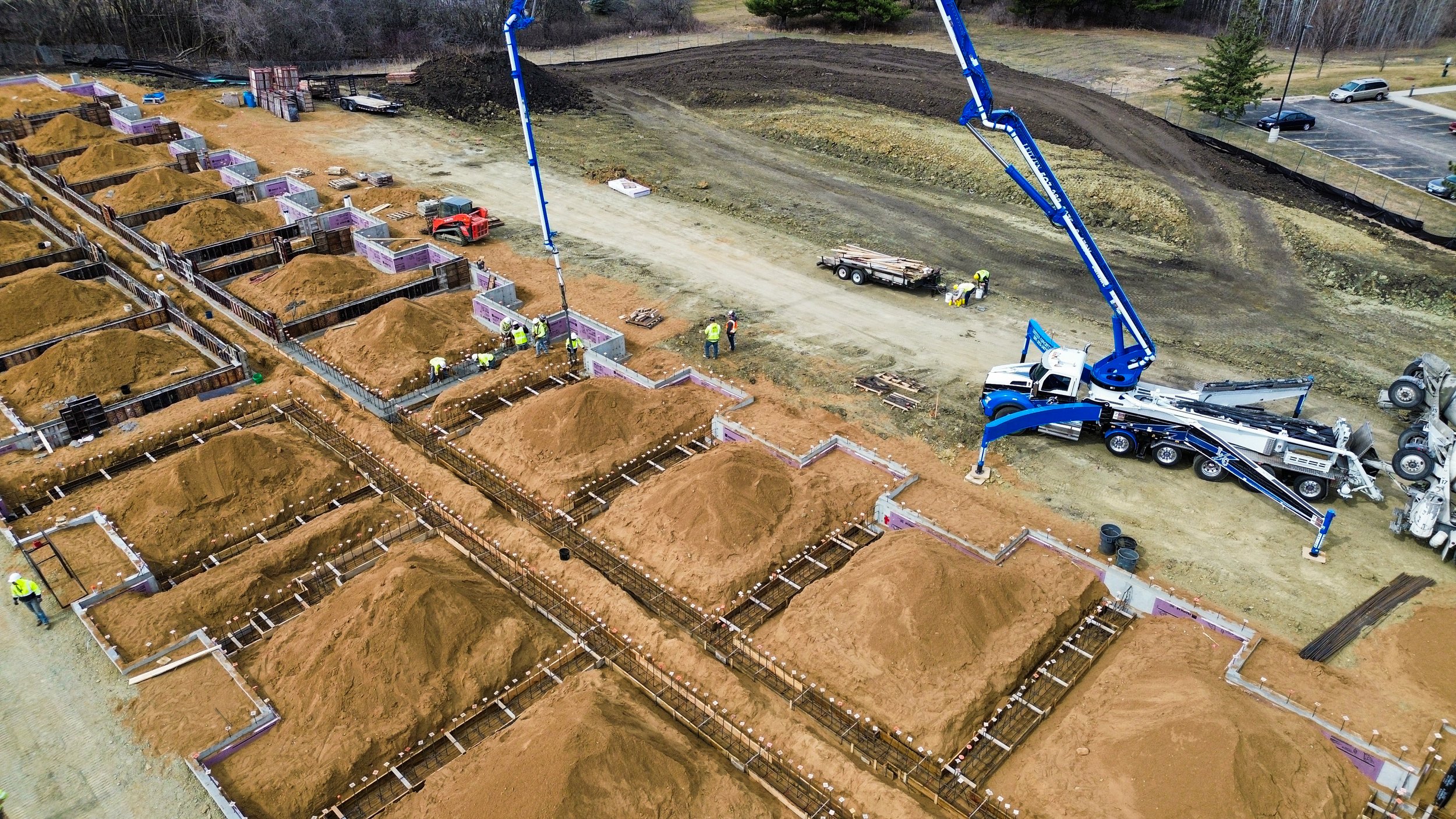
Coordinating material deliveries (often thousands of cubic yards)
Managing labor and equipment availability
A well-coordinated plan ensures that every phase—from excavation to finishing- flows seamlessly.
The Importance of Proper Concrete Mix Design
Not all concrete is created equal. For large-scale construction, the mix design must be tailored to the specific application and environmental conditions.
Key Considerations:
Compressive Strength Requirements (e.g., 4,000–6,000+ PSI)
Workability and Placement Needs
Admixtures for Set Time and Durability
Environmental Factors (temperature, humidity, wind)
Using the wrong mix can lead to cracking, reduced strength, and costly repairs down the line.

Execution: From Pour to Finish
Executing large scale concrete construction requires precision, coordination, and experienced crews.
Placement
High-volume pours often require pump trucks and laser screeds
Continuous pours may run for hours—or even days
Finishing
Achieving proper flatness and smoothness is critical for operational efficiency
Techniques include power troweling and laser-guided leveling
Joint Installation
Control joints help manage cracking
Proper spacing and timing are essential
Common Challenges in Large Scale Concrete Projects
Even with the best planning, large scale concrete construction comes with its challenges.
Weather Conditions
Temperature swings, wind, and precipitation can impact curing and finishing.
Cracking and Shrinkage
Improper joint placement or curing can lead to structural and aesthetic issues.
Scheduling Delays
Large pours require tight coordination—any delay can impact the entire project timeline.
Labor and Equipment Coordination
Managing crews, subcontractors, and specialized equipment is critical for efficiency.
Working with experienced professionals helps mitigate these risks and keep projects on track.
Technology in Modern Concrete Construction
Advancements in technology are transforming how large scale concrete projects are executed.
Innovations Include:
Laser Screed Technology for precise leveling
Drones and Site Monitoring for progress tracking
3D Modeling and BIM for better coordination
Advanced Admixtures for performance enhancement
These tools improve accuracy, reduce waste, and enhance overall project outcomes.
Cost Factors in Large Scale Concrete Construction
Understanding cost drivers helps owners and developers plan more effectively.
Key Cost Factors:
Material prices (cement, aggregates, additives)
Labor and equipment
Site conditions and preparation
Project size and complexity
Weather and seasonal impacts
While large scale concrete construction requires significant upfront investment, the long-term durability and performance often result in lower lifecycle costs.
Choosing the Right Concrete Contractor
Not all contractors are equipped to handle large scale concrete construction. Choosing the right partner is critical.
Look For:
Proven experience with large commercial projects
Strong safety record
Advanced equipment and technology
Knowledge of local conditions and codes
Clear communication and project management
A trusted contractor brings expertise, efficiency, and peace of mind to complex builds.
Why Large Scale Concrete Construction Matters
From logistics hubs to healthcare facilities, large scale concrete construction supports the infrastructure that keeps industries moving. These projects are more than just foundations—they are investments in performance, safety, and long-term success.
Build Smarter with Experienced Concrete Professionals
Large scale concrete construction isn’t just about pouring concrete—it’s about precision, planning, and performance at every stage. From mix design to curing, every detail matters.
At Evenson Concrete Systems, we specialize in delivering high-quality concrete solutions for large commercial and industrial projects. Our team understands the complexities of large scale construction and brings the expertise needed to execute with confidence.
Ready to start your next project?
Contact Evenson Concrete Systems today to learn how we can help you build stronger, smarter, and more efficiently.